
p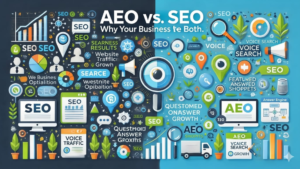
today’s rapidly transforming digital environment, businesses are continually adjusting their strategies to better connect with their target audience. The way people search for information has evolved beyond simply entering keywords into search engines—users now depend on voice search, AI-driven platforms, and interactive, conversational technologies to get instant results. This progression has given rise to a new approach that complements traditional Search Engine Optimization (SEO): Answer Engine Optimization (AEO).
While SEO has traditionally served as the foundation for online visibility, AEO marks the next phase of digital optimization—prioritizing direct, accurate responses instead of merely improving page rankings. Recognizing the distinction between SEO and AEO is crucial for marketers, organizations, and content creators who want to remain relevant and competitive in an increasingly dynamic online landscape.
What is SEO?

Search Engine Optimization (SEO) is a structured method of elevating a website’s presence across search engine results pages (SERPs). Its fundamental objective is to achieve top positions for targeted search terms, making it simple for users to access your content when seeking relevant information, products, or services.
SEO encompasses several key practices, including:
Search term research and placement: Identifying high-intent queries and weaving them seamlessly into content
- On-page structuring: Enhancing page elements such as headings, meta descriptions, and internal navigation for better clarity and relevance
- Technical fine-tuning: Optimizing loading performance, ensuring responsiveness across devices, and improving crawl efficiency
- Off-site authority building: Gaining trust and credibility through quality backlinks and external recognition
Traditional SEO is largely centered on generating website traffic. Pages that secure higher rankings are more visible to users, which increases the likelihood of clicks and helps maintain a consistent flow of visitors over time.
What is AEO?

Answer Engine Optimization (AEO) is the strategy of designing content to provide fast, precise, and clearly organized answers to user questions, especially within advanced AI-driven search systems. Instead of concentrating only on higher rankings, AEO focuses on making content the most dependable and contextually relevant response for voice searches, enhanced snippets, and AI-generated outputs.
AEO is purpose-built for:
- Voice-enabled digital assistants (such as Siri, Alexa, and Google Assistant)
- Artificial intelligence–based search and discovery systems
- Featured snippets (widely known as “position zero” results)
- Context-driven, conversational search interactions
With AEO, the emphasis goes far beyond simple online presence—it focuses on delivering immediate, precise, and contextually relevant answers, ensuring content is perceived as credible, insightful, and perfectly matched to user intent.
The Key Difference Between SEO and AEO
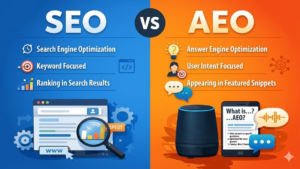 The primary difference between SEO and AEO is rooted in their objective and how they present information to users.
- SEO focuses on drawing users to your website
- AEO focuses on supplying the precise answer directly to the user
While SEO emphasizes boosting page rankings to enhance visibility and drive traffic, AEO is centered on providing fast, accurate, and contextually relevant answers that immediately satisfy user intent.
Evolution of Search Behavior

The evolution of search behavior can be reimagined as a gradual metamorphosis in the way individuals seek, interpret, and engage with digital information.
In the nascent phase of the internet, search habits were largely mechanical and term-driven. Users depended on succinct, rigid keyword strings, often lacking nuance or contextual depth. The interaction was transactional—focused more on retrieval than understanding. Over time, search systems matured, integrating semantic intelligence and contextual awareness, enabling them to decipher intent rather than merely recognize isolated terms.
As digital ecosystems expanded and smartphones became ubiquitous, search patterns grew more fluid and spontaneous. Queries shifted from clipped phrases to articulate, question-oriented expressions. The emergence of voice-enabled interfaces further humanized this process, encouraging conversational, almost dialogue-like interactions between users and technology.
Contemporary search behavior is deeply influenced by personalization and predictive intelligence. Algorithms now curate results based on behavioral signals, geolocation, preferences, and prior interactions, crafting a uniquely tailored discovery experience for each user.As a result, search has evolved from a general tool to a flexible, user-focused experience.
Moreover, the proliferation of multimedia content has diversified search modalities. Users increasingly gravitate toward visual cues, immersive videos, and interactive elements, moving beyond traditional text-based exploration.
In essence, search behavior has transitioned from a linear, input-output mechanism into a dynamic, intuitive, and contextually enriched experience—one that mirrors human thought processes and continuously adapts to evolving digital expectations.
How SEO Works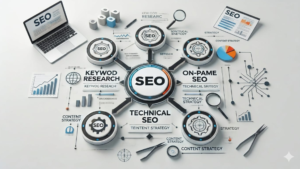
SEO operates through a structured approach:
Keyword Targeting
finding popular, pertinent terms that correspond with user intent.
Content Creation
Developing detailed and optimized content that includes keywords naturally.
Backlink Building
Gaining links from other websites to improve authority and trustworthiness.
Technical Optimization
ensuring that websites are quick, safe, and simple for search engines to index.
SEO success is often measured through:
- Rankings
- Organic traffic
- Click-through rates (CTR)
How AEO Works
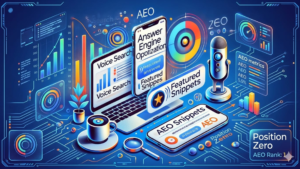 The primary differwers using structured and clear content.
Question-Based Content
Content is designed around questions users commonly ask.
Structured Data
Using schema markup to help search engines understand content better.
Concise Answers
Providing short, clear responses (often within 40–60 words).
Voice Optimization
Writing in a conversational, natural tone is appropriate for voice inquiries.
AEO success is measured through:
- Featured snippet placement
- Voice search visibility
- Inclusion in AI-generated answers
SEO vs AEO: Detailed Comparison
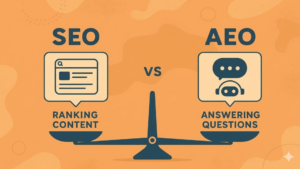
The difference between SEO and AEO becomes clearer when examining their core elements and how they approach user engagement. SEO primarily concentrates on improving the ranking of web pages within search engine results, with the ultimate aim of increasing website traffic. It relies heavily on long-form, keyword-optimized content designed to attract users and encourage them to click through to a website.The interaction between users is contingent upon the page’s visit, as search rankings, organic traffic, and click-through rates are the primary metrics used to evaluate SEO success.
In contrast, AEO is centered on delivering direct and immediate answers to user queries. Instead of focusing on page rankings, it prioritizes providing concise, question-focused content that can be easily understood by voice assistants and AI-driven platforms. AEO is tailored for voice and conversational search environments, where users expect quick responses without needing to navigate multiple links. Its effectiveness is measured by visibility in featured snippets, answer boxes, and AI-generated responses. Unlike SEO, AEO minimizes the need for user clicks, as the information is delivered instantly within the search interface itself.
Importance of SEO in Digital Marketing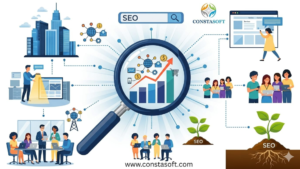
SEO remains a fundamental strategy for online growth. It helps businesses:
- Increase organic traffic
- Build brand credibility
- Generate leads and sales
- Improve online visibility
Even with the rise of AEO, SEO is still essential because users continue to rely on traditional search methods.
Importance of AEO in Modern Search
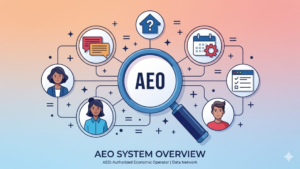
AEO is becoming increasingly important due to the growing use of AI and voice technologies.
Faster Information Access
Users favor prompt responses that do not necessitate exploring numerous pages.
Zero-Click Searches
Numerous users obtain their responses directly from search results without clicking on any hyperlinks.
Competitive Advantage
Being featured as the top answer increases brand authority and trust.
How to Optimize for SEO

To succeed with SEO, consider the following strategies:
- Use Relevant Keywords
Conduct research and incorporate keywords that correspond to user intent.
- Create High-Quality Content
Put your attention on worthwhile, educational, and interesting information.
- Improve Website Performance
Make sure it loads quickly and is responsive on mobile devices.
- Build Backlinks
To increase authority, obtain links from respectable websites.
- Optimize Metadata
To get clicks, use attention-grabbing titles and descriptions.
How to Optimize for AEO

AEO requires a slightly different approach:
- Answer Questions Clearly
Start your material with direct responses to frequently asked questions.
- Use Structured Formats
Include bullet points, lists, and tables for clarity.
- Implement Schema Markup
Make your content easier for search engines to understand.
- Focus on Conversational Language
Write in a natural tone that matches how people speak.
- Target Featured Snippets
Content should be structured to show up in “position zero” results.
Combining SEO and AEO
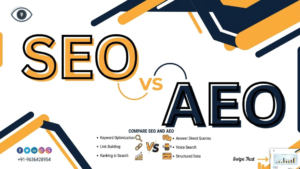
Combining both AEO and SEO is a better option than picking just one.
Hybrid Approach
Use SEO to drive traffic
Use AEO to capture instant answers
Content Strategy
Create long-form content (SEO) with clear, concise answer sections (AEO).
Example
A blog post can:
Rank on Google (SEO)
Appear in a featured snippet (AEO)
Be used in voice search responses (AEO)
Challenges of AEO

While AEO offers many advantages, it also presents challenges:
Reduced Website Traffic
Users may get answers without visiting your site.
Limited Visibility Space
Only one or a few answers are selected.
Increased Competition
Many websites compete for the same featured snippet.
Future of Search: SEO or AEO?

The future of search is not about choosing one over the other—it’s about integration.
AI Will Dominate Search
Search engines will continue evolving into answer engines.
Content Must Be Smarter
Content should focus on intent, clarity, and value.
Voice Search Will Grow
Optimizing for spoken queries will become essential.
User Experience Will Be Key
Providing accurate and fast information will determine success.
Conclusion

SEO and AEO function as two interconnected strategies within the evolving world of digital marketing. While SEO is primarily focused on boosting online visibility and attracting user traffic, AEO is designed to deliver fast, accurate, and direct responses that immediately fulfill user intent.
Because search technology are constantly evolving, relying only on traditional SEO is no longer adequate. Businesses must adapt by embracing AEO techniques to remain competitive in an AI-driven ecosystem. The real strength lies in combining both approaches—creating content that not only achieves strong rankings but also provides clear, relevant, and instant answers.
By integrating the broad reach of SEO with the speed and precision of AEO, businesses can enhance their online presence, connect with a wider audience, and stay ahead in an increasingly dynamic and competitive digital landscape.